

Hey there! As a supplier of zinc alloy joints, I often get asked about the ductility of these little but crucial components. So, let's dive right in and talk about what the ductility of zinc alloy joints really means.
First off, what's ductility? Well, ductility is the ability of a material to be stretched or drawn out into a thin wire without breaking. In the case of zinc alloy joints, it's all about how well they can withstand deformation under tensile stress. You see, in a lot of applications, zinc alloy joints are subjected to forces that try to pull them apart or stretch them. If they're not ductile enough, they'll crack or break, which can lead to all sorts of problems down the line.
So, why is ductility so important for zinc alloy joints? For starters, in many mechanical systems, these joints need to adapt to different movements and stresses. Let's say you're using zinc alloy joints in a piece of machinery that has some vibrations or slight movements during operation. A joint with good ductility can bend and stretch a bit to accommodate these movements without failing.
Think about it like this: if you have a rigid joint that can't bend at all, any small movement or stress that it wasn't exactly designed for can cause it to break. But a ductile joint can act like a little shock absorber, taking on some of that stress and adjusting without losing its integrity.
Now, in the real - world applications, the ductility of zinc alloy joints plays a huge role. Take the automotive industry for example. There are lots of places where zinc alloy joints are used, like in the Push Pull Cable systems. These cables are used to control various functions in a vehicle, and the joints need to be able to handle the constant pushing and pulling forces. If the joints aren't ductile enough, they might break, which could lead to a malfunction in the system.
Another example is in the Cable End Fitting. These fittings often need to be attached to cables in a way that can withstand different types of forces. A ductile zinc alloy joint can be bent and shaped during the installation process to fit properly, and then it can handle the day - to - day stresses that come with normal use.
The Adjustable Screw Joint is yet another area where ductility is key. These joints are designed to be adjusted, which means they need to be able to withstand the twisting and turning forces that come with the adjustment process. A ductile zinc alloy can handle these forces without cracking or losing its strength.
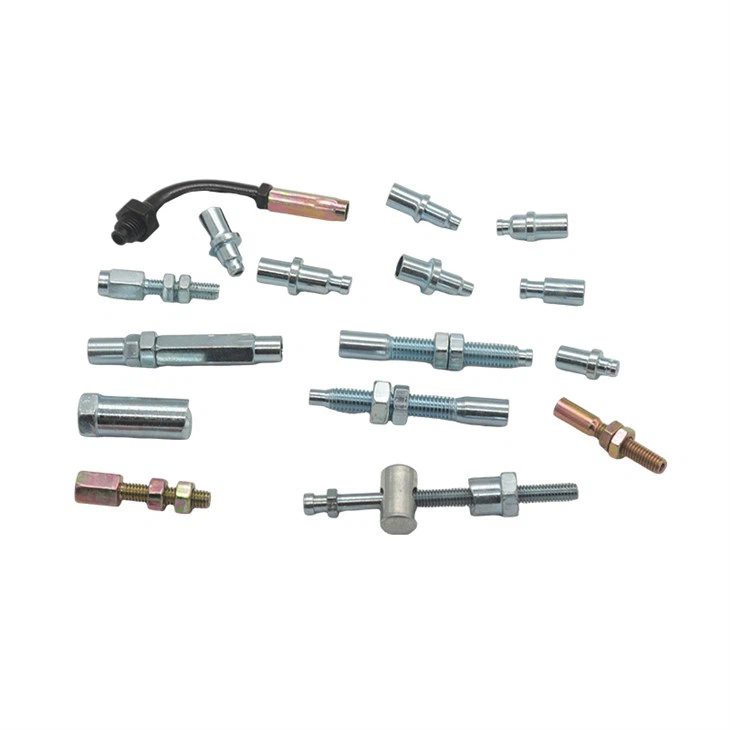

Now, how do we measure the ductility of zinc alloy joints? There are a few ways. One common method is the tensile test. In a tensile test, a sample of the zinc alloy joint is pulled at a constant rate until it breaks. During this process, the amount of deformation the sample can undergo before breaking is measured. This gives us an idea of how ductile the alloy is.
The composition of the zinc alloy also plays a big role in its ductility. Different alloying elements can be added to zinc to change its properties. For example, adding small amounts of copper can increase the strength of the alloy, but it might also reduce its ductility a bit. On the other hand, adding some other elements in the right proportions can actually improve the ductility.
As a supplier, I've seen firsthand how important it is to get the balance right. We spend a lot of time in the lab, testing different alloy compositions to find the perfect mix that gives our zinc alloy joints the right amount of ductility for different applications.
When it comes to choosing the right zinc alloy joint for your needs, you need to consider the level of ductility required. If your application involves a lot of movement and stress, you'll want a joint with high ductility. But if the joint is going to be in a more static position and doesn't need to bend much, you might be able to get away with a joint that has slightly lower ductility.
We also need to talk about the manufacturing process. The way the zinc alloy joints are made can have a big impact on their ductility. For example, if the casting process isn't done correctly, there might be defects in the joint that can reduce its ductility. At our place, we use state - of - the - art manufacturing techniques to ensure that our joints have consistent and high - quality ductility.
In addition to the mechanical properties, the surface finish of the zinc alloy joints can also affect how well they perform in terms of ductility. A smooth surface finish can reduce the stress concentration points on the joint, which means it can better withstand deformation. We take great care in the finishing process to make sure our joints have the best possible surface finish.
Now, if you're in the market for high - quality zinc alloy joints, we're here to help. Whether you need joints for automotive applications, industrial machinery, or any other use, we've got a wide range of products to choose from. Our team of experts can work with you to understand your specific requirements and recommend the right zinc alloy joints with the appropriate ductility.
If you're interested in learning more or want to start a procurement discussion, don't hesitate to reach out. We're always happy to talk about our products and how they can fit into your projects.
In conclusion, the ductility of zinc alloy joints is a crucial factor that can make or break the performance of your systems. By understanding what ductility is, how it's measured, and how it impacts different applications, you can make more informed decisions when it comes to choosing the right joints for your needs.
References
- "Materials Science and Engineering: An Introduction" by William D. Callister, Jr. and David G. Rethwisch
- Automotive Engineering Handbooks for relevant industry - specific information on cable systems and joints.