

The dynamic response of an adjustable screw joint is a crucial aspect to understand, especially for those involved in the field of mechanical engineering and automotive applications. As a supplier of Adjustable Screw Joints, I have witnessed firsthand the significance of this component and its dynamic behavior in various systems.
Understanding the Basics of an Adjustable Screw Joint
An adjustable screw joint is a mechanical device that allows for the adjustment of length or tension in a system. It typically consists of a threaded rod and a nut, which can be turned to change the position or tension of the joint. These joints are commonly used in applications where precise adjustment is required, such as in the automotive industry for Cable End Fitting, Bowden Cable, and other similar components.
The basic principle behind an adjustable screw joint is the conversion of rotational motion into linear motion. When the nut is turned on the threaded rod, it moves along the rod, either extending or retracting the joint. This simple yet effective mechanism provides a reliable way to make adjustments in a system.
Factors Affecting the Dynamic Response
Several factors can influence the dynamic response of an adjustable screw joint. One of the primary factors is the material properties of the components. The strength, stiffness, and friction characteristics of the threaded rod and nut can significantly impact how the joint responds to dynamic loads. For example, a high - strength material may be able to withstand greater forces without deforming, while a material with low friction can allow for smoother adjustment.
The thread pitch of the screw also plays a crucial role. A finer thread pitch provides more precise adjustment but may result in a slower response time, as more rotations of the nut are required to achieve a given linear displacement. On the other hand, a coarser thread pitch allows for faster adjustment but may sacrifice some precision.
Another important factor is the pre - load applied to the joint. Pre - loading is the initial tension or compression applied to the joint before any external loads are applied. A proper pre - load can improve the stability and dynamic performance of the joint by reducing the likelihood of loosening under dynamic loads. However, excessive pre - load can lead to increased stress on the components and may even cause premature failure.
The operating environment can also affect the dynamic response. Temperature, humidity, and the presence of contaminants can all impact the performance of the adjustable screw joint. For instance, high temperatures can cause the material to expand, which may change the fit between the threaded rod and nut and affect the adjustment accuracy.
Dynamic Loading Conditions
In real - world applications, adjustable screw joints are often subjected to dynamic loads. These loads can be cyclic, such as the vibrations experienced in a vehicle engine, or sudden and impulsive, like the impact forces during a vehicle collision.
Under cyclic loading, the adjustable screw joint may experience fatigue. Fatigue occurs when a material is subjected to repeated loading and unloading, causing microscopic cracks to form and gradually grow over time. This can lead to a reduction in the strength of the joint and eventually result in failure. To mitigate the effects of fatigue, proper design and material selection are essential. For example, using materials with high fatigue resistance and optimizing the thread geometry can help improve the joint's performance under cyclic loading.
Impulsive loads can also pose challenges to the adjustable screw joint. These loads can cause sudden changes in the tension or compression of the joint, which may lead to loosening or even damage to the components. To handle impulsive loads, the joint may need to be designed with additional features, such as locking mechanisms or shock - absorbing elements.
Measuring and Analyzing the Dynamic Response
To understand the dynamic response of an adjustable screw joint, various measurement and analysis techniques can be employed. One common method is to use strain gauges to measure the stress and strain in the components. Strain gauges are small sensors that can be attached to the surface of the threaded rod or nut to measure the deformation caused by the applied loads. By analyzing the strain data, it is possible to determine the stress levels in the joint and assess its performance under dynamic conditions.
Another technique is vibration analysis. Vibration sensors can be used to measure the vibrations of the adjustable screw joint during operation. By analyzing the frequency, amplitude, and phase of the vibrations, it is possible to detect any abnormal behavior, such as looseness or misalignment. This information can be used to diagnose problems and make necessary adjustments to improve the joint's performance.
Finite element analysis (FEA) is also a powerful tool for analyzing the dynamic response of adjustable screw joints. FEA is a numerical method that can be used to simulate the behavior of the joint under various loading conditions. By creating a detailed model of the joint and applying the appropriate boundary conditions and loads, FEA can provide insights into the stress distribution, deformation, and other aspects of the joint's performance.
Importance in Automotive Applications
In the automotive industry, adjustable screw joints are widely used in Cable End Fitting and Bowden Cable systems. These joints are used to adjust the tension of cables, which is crucial for the proper operation of various components, such as brakes, clutches, and throttle controls.
The dynamic response of the adjustable screw joint in these applications is of utmost importance. For example, in a brake cable system, a joint with a poor dynamic response may not be able to maintain the correct tension under the vibrations and forces experienced during vehicle operation. This can lead to a decrease in braking performance and potentially pose a safety hazard.
In a throttle control system, the adjustable screw joint needs to respond quickly and accurately to changes in the driver's input. A slow or inaccurate response can result in poor engine performance and reduced fuel efficiency.
Applications in Other Industries
Beyond the automotive industry, adjustable screw joints are also used in many other industries. In the aerospace industry, they are used in aircraft control systems to adjust the position of control surfaces. The dynamic response of these joints is critical for ensuring the safe and precise operation of the aircraft.

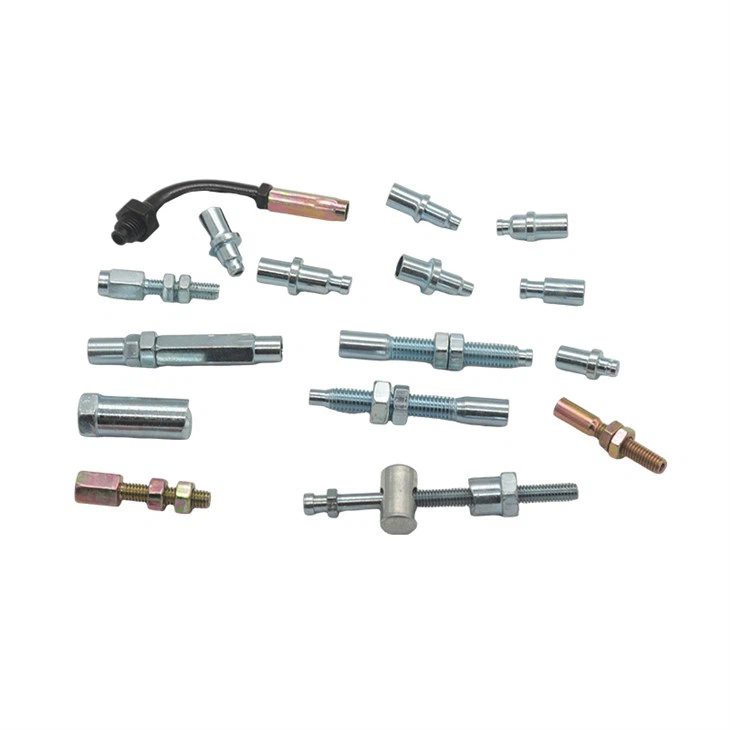
In the manufacturing industry, adjustable screw joints are used in machine tools to adjust the position and alignment of components. The ability to make precise adjustments quickly and accurately is essential for maintaining the quality of the manufactured products.
Our Role as a Supplier
As a supplier of Adjustable Screw Joints, we understand the importance of providing high - quality products with excellent dynamic response. We use advanced manufacturing techniques and high - quality materials to ensure that our joints meet the strictest standards.
We also offer customized solutions to meet the specific needs of our customers. Whether it is a unique thread pitch, a special material requirement, or a specific pre - load specification, we can work with our customers to design and manufacture the ideal adjustable screw joint for their application.
In addition to providing high - quality products, we also offer technical support to our customers. Our team of engineers can assist with the selection of the appropriate adjustable screw joint, the analysis of the dynamic response, and the troubleshooting of any problems that may arise.
Contact Us for Procurement
If you are in need of adjustable screw joints for your application, we invite you to contact us for procurement. Our team is ready to discuss your requirements and provide you with the best solutions. We are committed to providing you with high - quality products and excellent service to help you achieve your goals. Whether you are in the automotive, aerospace, or manufacturing industry, we have the expertise and products to meet your needs.
References
- Shigley, J. E., & Mischke, C. R. (2001). Mechanical Engineering Design. McGraw - Hill.
- Budynas, R. G., & Nisbett, J. K. (2011). Shigley's Mechanical Engineering Design. McGraw - Hill.
- Dowling, N. E. (2012). Mechanical Behavior of Materials: Engineering Methods for Deformation, Fracture, and Fatigue. Pearson.